What AI employment laws are taking effect in the United States in 2026 and 2027?
Between today and January 1, 2027, five requirements take effect: Connecticut's CART Act (October 1, 2026), California's AI Transparency Act (August 2, 2026), and three laws effective January 1, 2027, Colorado's Automated Decision-Making Technology Law, California's ADMT Regulations, and New York's RAISE Act. Illinois's AI Disclosure Law, Texas's TRAIGA, Connecticut's CTDPA amendment, and Oregon's privacy law are already in effect. New York City's Local Law 144 has applied since 2023. Illinois also just signed a second, later law, the Artificial Intelligence Safety Measures Act, tracked here even though it does not take effect until January 1, 2028.
Does my company need to comply with the Colorado AI Act?
The original Colorado AI Act was repealed before it took effect. It has been replaced by SB 26-189, effective January 1, 2027, which applies to developers and deployers of automated decision-making technology used in consequential decisions, including employment. If your organization uses AI to help decide hiring, promotion, compensation, or termination for anyone in Colorado, this applies to you.
Does Illinois have more than one AI law affecting employers?
Yes, two separate ones. The AI Disclosure Law (Public Act 103-0804), effective January 1, 2026, amends the Illinois Human Rights Act and covers discriminatory AI use and employee notice across hiring, promotion, and other employment decisions. The Artificial Intelligence Safety Measures Act (SB 315), signed July 6, 2026, is a separate frontier-model safety law aimed at the largest AI developers, not at HR decisions directly, and does not take effect until January 1, 2028.
Does Texas require AI bias audits or employee notices like Colorado and Illinois?
No. TRAIGA, effective January 1, 2026, does not mandate bias audits or AI-use notices. It instead prohibits specific intentional misuses of AI, including intentional discrimination against a protected class, and is enforced exclusively by the Texas Attorney General. Disparate impact alone does not violate the law; intent has to be shown.
What is the difference between a developer and a deployer under state AI laws?
A developer builds or substantially modifies the AI system. A deployer is the organization that uses it, which means most HR departments are deployers, not developers, even when the tool comes from a vendor. Deployer obligations typically include notice, disclosure, and risk assessment. Developer obligations typically include documentation and testing support. Most state laws place the heavier operational burden on deployers.
What counts as a high-risk or consequential decision AI system in employment?
Generally, any AI tool that makes or is a substantial factor in decisions about hiring, promotion, compensation, discipline, or termination. The exact definition varies by state. Colorado and California both use consequential decision language; earlier frameworks used high-risk. Read the specific statute before assuming a tool falls outside the definition.
Do AI hiring law obligations apply to small businesses, or only large employers?
It depends on the law. Some, like Illinois's amendment to the Human Rights Act, apply broadly with few size exemptions. Others, like New York's RAISE Act, only reach the largest frontier AI developers and carry no direct HR obligation. Check the covered employer definition on each entry above; do not assume small size means no exposure.
What is an AI impact assessment, and who has to complete one?
A written assessment covering the AI system's purpose, the data it uses, how it was tested, what risks it presents, and what safeguards are in place. Deployers of covered high-risk or consequential-decision AI systems are typically responsible for completing it, not the vendor who built the tool.
What happens if my organization doesn't comply with a state AI employment law?
Enforcement varies by state. Several of these laws, including Connecticut's CART Act and Colorado's ADMT law, are enforced exclusively by the state Attorney General as unfair or deceptive trade practices, with no private right of action. Others, like Illinois's amendment, allow civil penalties up to $5,000 per violation. None of them offer a formal safe harbor. Documented governance is the closest thing to one.
Is there a federal AI employment law, or is this state-by-state only?
As of this tracker's last update, there is no comprehensive federal AI employment law. Coverage is state by state, which is why an organization operating in multiple states can face several different obligations for the same AI tool.
How is the EU AI Act different from U.S. state AI employment laws?
The EU AI Act is a single comprehensive framework covering the full lifecycle of AI systems, with deployer obligations under Article 26 for employment use. U.S. state laws are narrower, more numerous, and inconsistent with one another. An organization with EU workforce exposure needs both compliance tracks, not just one.
What is NYC Local Law 144 and does it apply outside New York City?
Local Law 144 requires an annual independent bias audit of any automated employment decision tool used to screen candidates or evaluate employees for promotion in New York City, with results published and candidates notified. It applies to use of the tool for a role based in New York City, regardless of where the employer is headquartered.
Do AI-generated interview or resume-screening tools trigger disclosure requirements?
In most states with a notice requirement, yes. If the tool processes, scores, or ranks candidates, or materially influences a hiring decision, disclosure obligations typically apply, whether the interview involves synthetic video, automated scoring, or resume ranking.
What should HR do first to prepare for an upcoming AI compliance deadline?
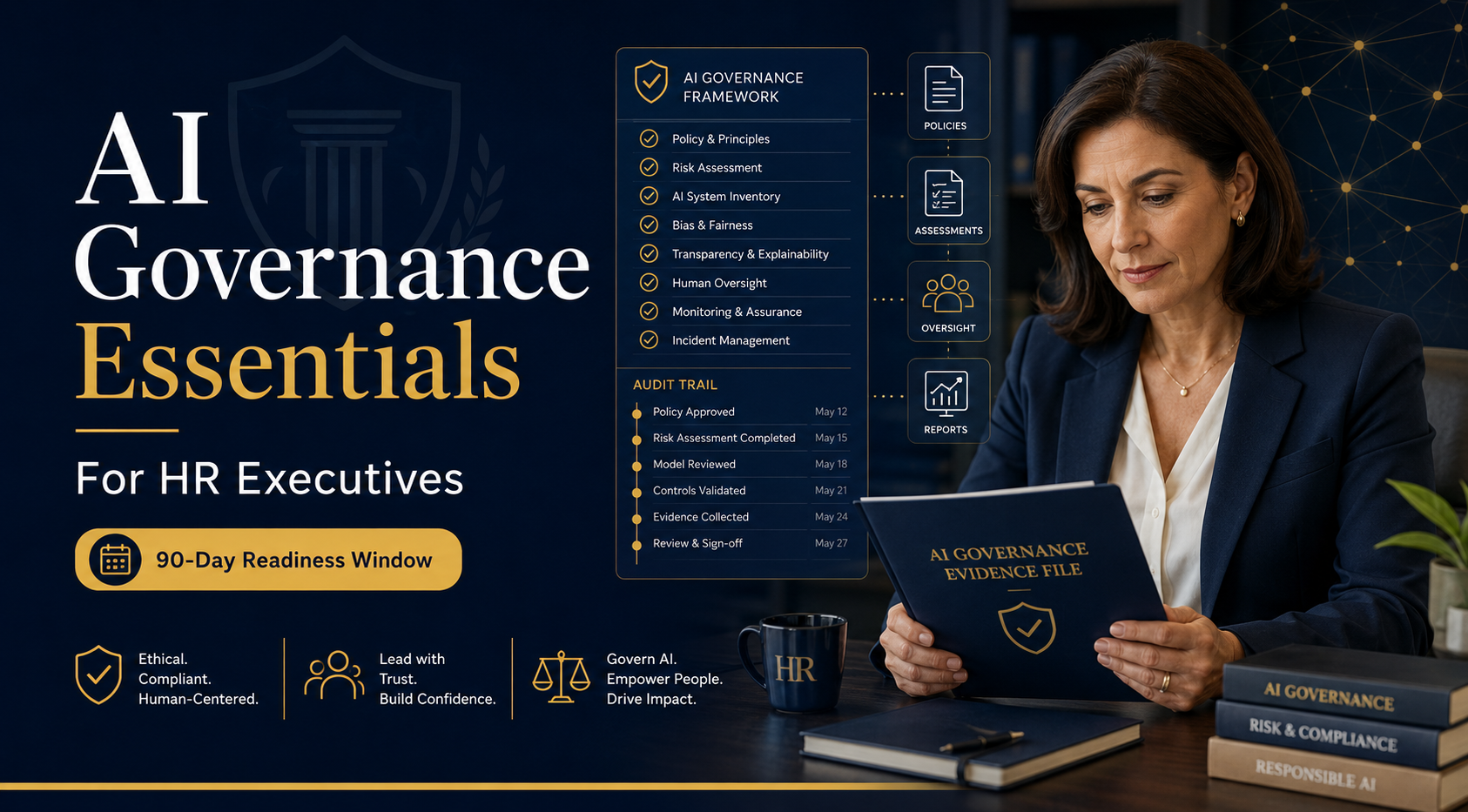
Start with an inventory: know every place AI touches a hiring, promotion, compensation, or termination decision before documenting anything else. You cannot govern what you have not mapped. This is the first step in the SimpliFocus™ AI Governance Framework for exactly that reason.
How often should this tracker be checked for updates?
This tracker is verified monthly at minimum, and immediately after any state passes new legislation or an agency issues implementing rules. The last-verified date at the top of the page shows exactly how current the information is.
Where can I find the official legal text for these AI employment laws?
Every entry on this page links directly to a primary source, the bill text, public act, or agency regulation page, not a law firm summary. Use the Official Source link on each card.