The Algorithm Made the Recommendation. Your Organization Made the Decision.
AI is already screening your candidates, scoring your people, and shaping who gets promoted. Regulators and courts treat those outputs as your employment decisions. Margaret Spence advises HR, Talent, Legal, and Risk leaders on governing AI across the full talent lifecycle, from the first policy to the board report.
Advisory sessions starting at $1,250Fixed-fee Gap AuditsFractional advisory
Margaret SpenceFractional AI Governance & Policy Advisor. HR · Talent · Workplace Risk.
What Is AI Governance Consulting for HR?
AI governance consulting for HR identifies where AI influences employment decisions and establishes the policies, accountability, human oversight, vendor controls, documentation, and monitoring needed to govern those decisions. Margaret Spence specializes in applying AI governance to hiring, Talent, HR technology, employee AI use, and workplace risk.
Why This Matters Now
The Law Has Stopped Accepting "The Software Decided."
Every requirement below lands on the employer that uses the tool. Most reach organizations headquartered in other states, because they follow where the applicant or employee sits.
Effective Oct 1, 2026
Connecticut
Using AI is no longer a defense to a discrimination complaint. WARN filings must disclose whether layoffs relate to AI.
In effect since Jan 1, 2026
Illinois
AI that produces a discriminatory effect in hiring, promotion, discipline, or discharge violates the Human Rights Act, with or without intent.
In effect since 2023
New York City
Annual independent bias audits, published results, and advance candidate notice for automated hiring and promotion tools.
Compliance by Jan 1, 2027
California
Risk assessments, pre-use notices, and opt-out rights for automated decision technology in significant employment decisions.
Effective Jan 1, 2027
Colorado
Advance notice and post-decision disclosure when automated decision technology drives hiring, pay, promotion, or termination.
Federal court, 2025
Mobley v. Workday
Age discrimination claims involving an AI screening vendor were allowed to proceed as a nationwide collective action.
Summaries only. Each requirement has scope limits and pending rules. This is not legal advice.
Most organizations govern AI as a technology question. The exposure sits in the employment decision the technology touches. This is where Margaret starts every engagement.
1
Sourcing & Job Ads
What the AI doesWrites postings, targets ads, and decides who sees the opening at all.
Where it breaksQualified candidates never see the role, and no one can show why.
2
Screening & Ranking
What the AI doesScores resumes, ranks applicants, and filters out who never reaches a human.
Where it breaksDisparate impact with no intent required, and a vendor contract that leaves the liability with you.
3
Assessments & Interviews
What the AI doesAnalyzes video interviews, game-based tests, and written responses.
Where it breaksAccommodation requests with no alternative process, and notice duties no one tracked.
4
Performance & Monitoring
What the AI doesGenerates review language, flags productivity, and summarizes manager notes.
Where it breaksA rating no manager can explain becomes the evidence in a retaliation or discrimination claim.
5
Promotion, Pay & Mobility
What the AI doesRecommends successors, internal moves, and compensation bands.
Where it breaksYesterday's inequities become tomorrow's training data, then a pattern a plaintiff can chart.
6
Discipline, Layoffs & Exit
What the AI doesInforms reduction-in-force lists, risk scores, and termination recommendations.
Where it breaksDisclosure duties on layoff filings and the highest-stakes decision with the thinnest record.
7
Everyday Employee AI Use
What the AI doesManagers and staff paste employee data, candidate notes, and investigations into public tools.
Where it breaksConfidential people data leaves the building under no policy at all.
Every stage needs the same four answers: what the tool does, who reviews it, what you can prove, and who owns the outcome.
Why HR Needs a Different Kind of AI Governance
Generic AI Consulting Governs the Model. You Answer for the Decision.
Most AI governance consulting is built for technology teams. What happens to HR?
Generic enterprise AI consulting compared with AI governance for HR and Talent
The Question
Generic AI Consulting
AI Governance for HR & Talent
Starting point
The technology stack and the model.
The employment decision the tool influences and the person on the other side of it.
Risk lens
Accuracy, uptime, data security.
Disparate impact, notice and disclosure duties, accommodation, retaliation, and claims exposure.
Vendor question
Does the tool perform as promised?
If the vendor's tool gets it wrong, whose liability is it, and what does the contract say?
Ownership
IT or a data team.
Named accountability across HR, Legal, IT, Risk, and leadership, with a path to the board.
Evidence
Model documentation.
The record a regulator, investigator, or plaintiff's attorney will ask for, built before they ask.
People
Tool training.
Managers who can explain, question, and override an AI-influenced decision.
Engagements & Investment
AI Governance Consulting Engagements & Pricing
Start where the pressure is. Go as far as the work requires.
Each engagement stands on its own. Most organizations begin with an advisory session or a Gap Audit, and the findings decide what comes next. You know the starting number before the first conversation.
Advise01
AI Governance Advisory Session
A two-hour working session on the AI governance decision in front of you.
For the leader with a decision to make now.
$1,250Two hours, one leader. $2,500 for up to five leaders.
Considering a Gap Audit, a build, or fractional advisory? A 20-minute scoping call confirms fit and the fee before any commitment. Workshops and executive briefings for boards and leadership teams are also available. All engagements are AI governance consulting, not legal advice.
The SimpliFocus™ AI Governance System, Applied to Your Organization
Margaret Spence's SimpliFocus™ AI Governance System is a six-step framework for identifying governance gaps, prioritizing risk, clarifying accountability, and moving from governance principles to organizational action. It is the system behind When AI Breaks the Law and every consulting engagement. An advisory session touches the first steps. A Gap Audit completes the first three. A build and a fractional relationship carry you through all six.
S
Scan
What AI systems do you have, and where are the failure patterns?
An inventory of AI across the talent lifecycle, including the tools no one approved, analyzed with Margaret's AI Failure Web Analysis™, a diagnostic that shows how individually rational decisions combine into discriminatory outcomes.
I
Investigate
Do you own what you think you own? What do your vendors owe you?
How each system reaches its output, what the contracts say, and which laws apply to your workforce.
M
Mitigate
What is your deployment decision gate?
Controls, bias testing, and Margaret's TRACE™ workflow, a verification-before-deployment protocol (Traceable, Reason-giving, Accountable, Challengeable, Epistemic-Education), before a tool touches an employment decision.
P
Protect
Who owns AI outcomes in your organization right now?
Policy, documentation, escalation paths, and a governance council with named accountability.
L
Lead
Is your governance individual-dependent or institutionalized?
An operating cadence, metrics, and reporting that survive turnover and reach the board.
I
Include
Can your people work alongside the systems you govern?
Manager readiness and upskilling pathways so governance shows up in daily decisions, not only in a binder.
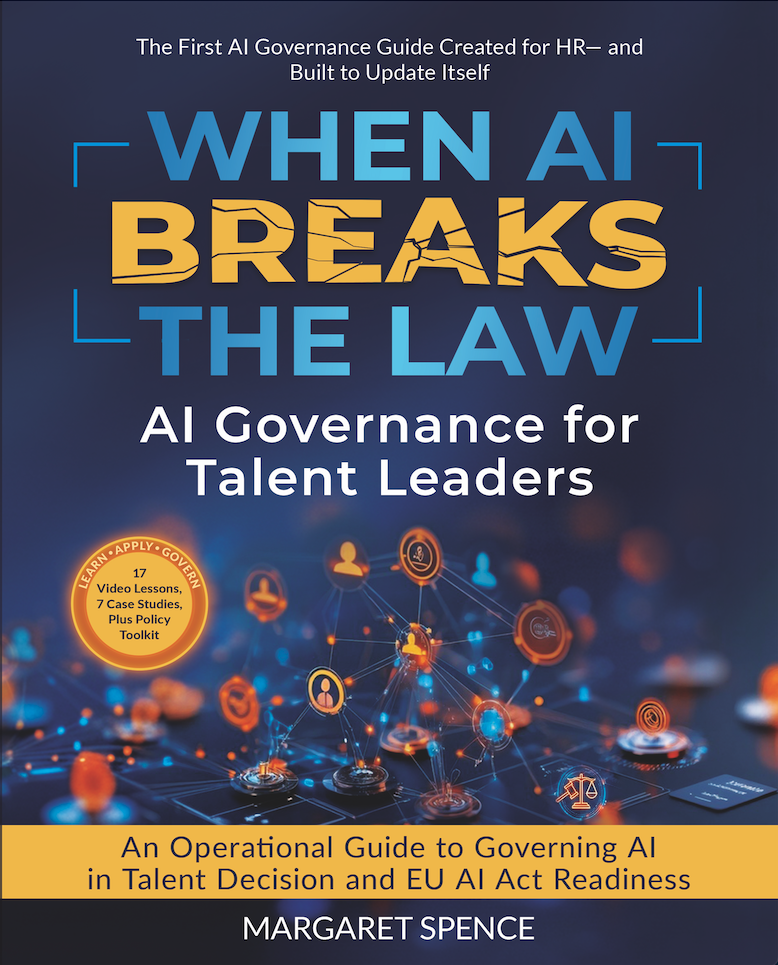
The SimpliFocus™ AI Governance System, AI Failure Web Analysis™, and TRACE™ are proprietary frameworks developed by Margaret Spence and published in When AI Breaks the Law.
Who Hires Margaret
Who Hires an AI Governance Consultant for HR?
Margaret works with organizations that use AI in hiring, Talent, HR technology, workforce management, or other employment decisions and need clearer governance, accountability, policy, and human oversight. That work crosses HR, Legal, IT, Risk, and leadership, so the people who hire her do too.
An AI Governance Consultant Who Started Where the Claims Land
Margaret Spence is an AI governance consultant, Fractional AI Governance & Policy Advisor, author, and former insurance risk executive specializing in AI governance for HR, Talent, employment decisions, AI Use Policies, and workplace risk.
Before AI governance had a name, Margaret was counting what bad people decisions cost.
She spent decades inside the rooms where workplace claims are investigated, defended, and paid, including more than $495 million in settled workplace claims across Fortune 500 companies. She has run her consulting firm since 1999.
She now advises HR, Talent, Legal, and Risk leaders on governing AI in employment decisions, AI Use Policies, HR technology, and workplace risk. She is the author of When AI Breaks the Law: AI Governance for Talent Leaders and maintains a public AI law tracker for HR.
Consulting Since 1999RMPE CertifiedCWC CertifiedFour Time Author$495M+ Settled Claims
Organizations Margaret Has Worked With
Not Ready to Talk Yet?
Start Here
See where your organization stands first. Each of these takes less time than the meeting where someone asks you about AI.
An AI governance consultant for HR identifies where AI influences employment decisions, from sourcing and screening to performance, promotion, and termination, then builds the policies, ownership, human review, vendor controls, and documentation that make those decisions defensible. Margaret Spence also advises on employee AI use and AI Use Policies.
How much does AI governance consulting cost?
Engagements with Margaret Spence start with a two-hour AI Governance Advisory Session at $1,250 for one leader or $2,500 for up to five leaders. AI Governance Gap Audits start at $7,500, policy and governance builds start at $4,500, and fractional advisory retainers start at $3,500 per month. Larger engagements are scoped after a 20-minute call.
What is an AI Governance Gap Audit?
A fixed-fee, three to four week engagement that inventories where AI is used across your talent lifecycle, maps that use against the employment laws that apply to your workforce, identifies ownership and documentation gaps, and delivers a prioritized roadmap and a leadership readout.
Is an AI Use Policy the same as AI governance?
No. An AI Use Policy sets rules for how employees and the organization use AI. AI governance covers ownership, approved tools, risk assessment, human oversight, vendor accountability, documentation, escalation, and monitoring. A policy is one part of governance, not a substitute for it. See AI Use Policy Consulting.
Do we need AI governance if we only use AI built into vendor HR tools?
Yes. Most AI employment laws place obligations on the employer that uses the tool, not only on the vendor that built it. Connecticut now states that using AI is not a defense to a discrimination complaint, and courts are allowing claims involving AI screening vendors to proceed. Governance is how you show what the tool does and who reviewed its output.
Which AI employment laws apply to our organization?
It depends on where your employees and applicants are located and which decisions AI influences. Requirements in New York City, Illinois, Connecticut, California, and Colorado reach employers headquartered elsewhere. Margaret maintains a public AI law tracker for HR and maps applicable requirements during a Gap Audit.
What AI systems should HR include in an AI governance review?
An HR AI governance review looks beyond standalone generative AI tools. Depending on the organization, it includes applicant tracking and recruiting systems, candidate screening and ranking tools, assessments, interview technology, HRIS or HCM features, performance management tools, workforce analytics, employee monitoring technology, generative AI, and the AI tools employees use in daily work. The objective is to find every place AI influences people, employment decisions, employee data, or workplace processes.
Can you review an AI Use Policy we already have?
Yes. An existing AI Use Policy can be reviewed for gaps in employee use, approved tools, sensitive data, HR and Talent decisions, human oversight, accountability, escalation, vendor use, and implementation. A review also shows whether the organization has a policy document but still lacks the governance structure needed to make it work. See AI Use Policy Consulting.
Do you work with Legal, IT, Risk, and Compliance teams as well as HR?
Yes. Margaret's specialization centers on HR, Talent, employment decisions, and workplace risk, but effective AI governance requires coordination across HR, Legal, IT, Risk, Compliance, Procurement, and executive leadership. Engagements clarify who owns what and where cross-functional governance is needed.
Do you work with nonprofit organizations?
Yes. Margaret works with nonprofit executives, HR and operations leaders, and boards on practical AI governance that protects employee, donor, and program information without creating bureaucracy the organization cannot maintain.
Is this legal advice?
No. Margaret Spence provides AI governance consulting and advisory services, not legal advice. When an issue requires legal counsel, she identifies it and clarifies the questions to bring to your attorney.
How do we start?
Book a two-hour AI Governance Advisory Session if you have a decision in front of you now. If you are considering a Gap Audit, a governance build, or fractional advisory, schedule a 20-minute scoping call.
When Your Board, a Regulator, or a Plaintiff Asks Who Governs the AI in Your Talent Decisions, What Will You Show Them?
Start with two hours on the decision in front of you, or a 20-minute call to scope the larger work.